
WSD4000 is a project name for our development female sexual health portfolio, starting with the creation of a range of topical gels under our unique platform technology, specifically designed to treat impaired sexual response or function (sexual dysfunction) in women, providing improvements in sexual desire, arousal, lubrication, pain during intercourse, orgasm and overall sexual satisfaction.
The range of gels, supported by a single phase 3 clinical programme, will comprise different consumer segments such as pre- and post-menopausal women.
Significant unmet needs in women’s sexual health
We commissioned Ipsos to carry out independent market research in the USA in 2024 to understand the unmet needs in women with symptoms of impaired sexual response and function as well as how common these symptoms were and what women thought of our product concept for WSD4000. The research included interviews with 40 women and an online survey with 1,000 women aged 22 to 75.
The results showed that symptoms are very common, affecting 6 in 10 women over the last twelve months. What we also saw is that this is not an issue that affects older women more than younger women. The percentage of women experiencing at least one symptom was similar across the age groups, with variations in the symptoms experienced. Most women experience more than one symptom and often there are causal relationships between the various symptoms. Many women are dissatisfied with the amount of sex they are having and wish they were having more.
INCIDENCE OF SYMPTOMS OF IMPAIRED SEXUAL RESPONSE AND FUNCTION IN WOMEN*
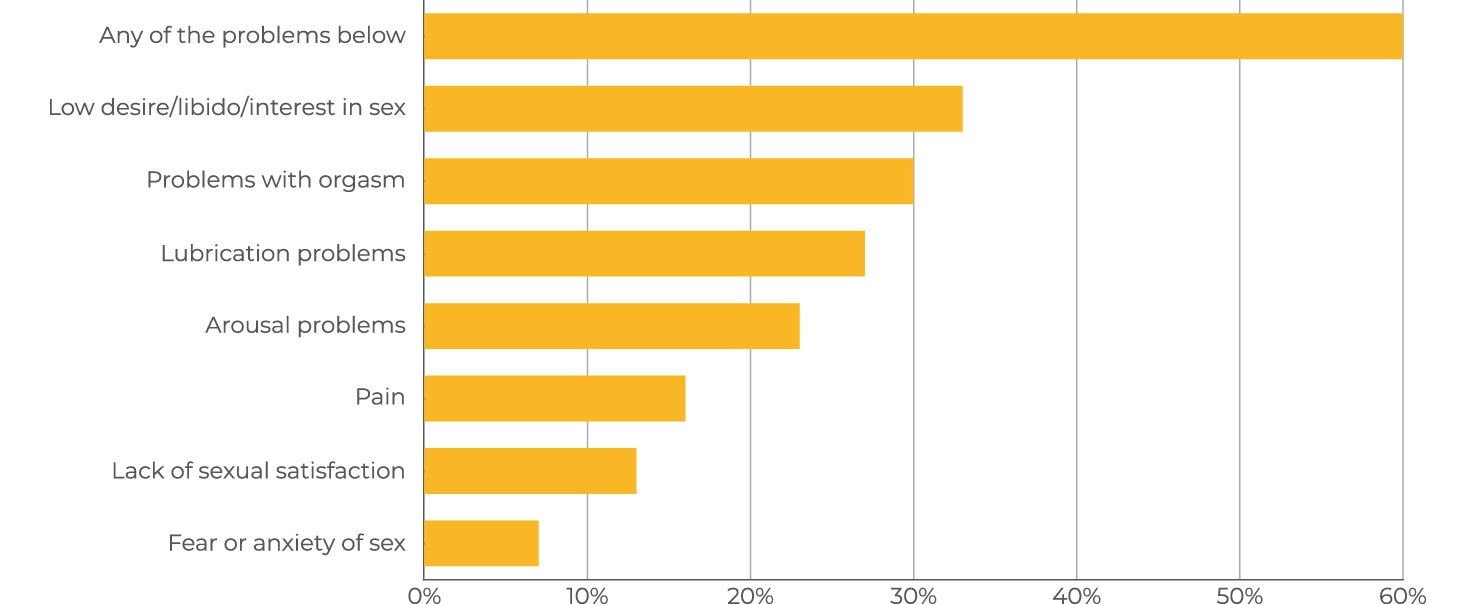
* This list consists of symptoms of impaired sexual response and function in women that WSD4000 is expected to treat and that women had experienced over the last twelve months.
Clinical development update
As part of the regulatory process, Futura met with the Food and Drug Administration (“FDA”) who indicated that an early feasibility study was a pre-requisite as this would be the first in class (De Novo) medical device with OTC classification for this indication. A small study was set up with 11 subjects completing the study (five pre-menopausal and six post-menopausal women) who had some degree of sexual dysfunction.
Encouraging Early Feasibility Study results (“EFS”)
The results were highly encouraging. Using the internationally recognised Total Female Sexual Function Index (“FSFI”) scale, a highly statistically significant improvement over baseline was achieved in overall sexual function. The product was fast acting and effective in both pre and post menopausal women. On average, an improvement in overall sexual function of 6.35 units over baseline (pre-treatment) in the FSFI scale was achieved which exceeded the minimal clinically important difference of 4 units defined by expert scientific consensus. Statistically significant improvements were achieved in five of the six FSFI domains: sexual arousal, lubrication, pain improvement, ability to orgasm and sexual satisfaction.
Using the Female Sexual Encounter Profile (“FSEP”) metrics, meaningful improvements were achieved in all measures and included:
- 84% of uses reported satisfaction with arousal
- 71% of uses reported enough lubrication for comfortable intercourse
- 70% of uses resulted in orgasm
Every use of the gel (56 in total) resulted in a genital sensation which occurred on average in less than five minutes in 9 out of 10 uses.
The product was well tolerated. 58% of subjects experienced a mild to moderate but transient "burning" sensation which in general led to higher efficacy levels indicating that subjects regarded this as a sensory signal that "the product was working". No subjects discontinued use of the product.
Development focus for 2026
Whilst the size of the EFS study was relatively modest, the results were highly encouraging and gave the Group confidence to proceed to the next steps of designing a single Phase 3 clinical study which will be further informed by both a small in-clinic sham (placebo) controlled sensory study and a 200 subject home user study with both sets of results expected in June 2026.
The strategy underpinning the current development of topical gels under the WSD4000 portfolio is based on one clinical trial to develop and launch multiple variants that meet the needs of women across multiple consumer segments, thereby maximising consumer appeal and relevance and commercial opportunity for distributors whilst keeping development costs, regulatory risk and time to market to a minimum.
The home user study, currently underway, recruited 200 women with some degree of sexual dysfunction to trial one of the products in the WSD4000 range at home with their partner over a four week period. This will enable Futura to understand the consumer’s real life experience of the product so that we can adapt the clinical development and positioning of the product based on consumer insights, highlighting our commitment to putting the consumer at the centre of product development.
The home user study will provide the insights needed for the development of the proposition for the WSD4000 portfolio and as part of the drive to ensure it meets women’s and commercial partners’ needs and expectations, the Group has recruited specialist marketing support to develop a global branding and portfolio architecture, understand the price acceptance and elasticity and validate a realistic global market opportunity.
Market opportunity
The reaction from women to the concept for WSD4000 was very positive. The concept was well received and resonated with women who felt it was written by women for women with 88% of respondents in the market research saying they would not change anything about the concept. As a concept it scored at the top of the Ipsos norms average with three areas scoring well above average including in particular “New and Different”. Interest was high and, depending on the price point, up to around 60% of women were likely or very likely to purchase WSD4000. The concept resonated particularly well in younger women.
The commercial opportunity is large and significant with an estimated 34 million women in the USA alone motivated to treat their symptoms of sexual dysfunction and 2 in 3 women dissatisfied with their treatment.
New Intellectual property
A new patent for WSD4000 was filed in February 2024, with the potential for further filings based on the outcomes of the studies. The innovation behind WSD4000 falls outside of existing commercial partner agreements for Eroxon®.